
La complessità non è confusione
Quando un problema sembra confuso, spesso lo stiamo guardando dalla scala sbagliata.
Complexity is Not Confusion
When a problem appears confused, it is often being observed from the wrong scale.
English version below
ITA
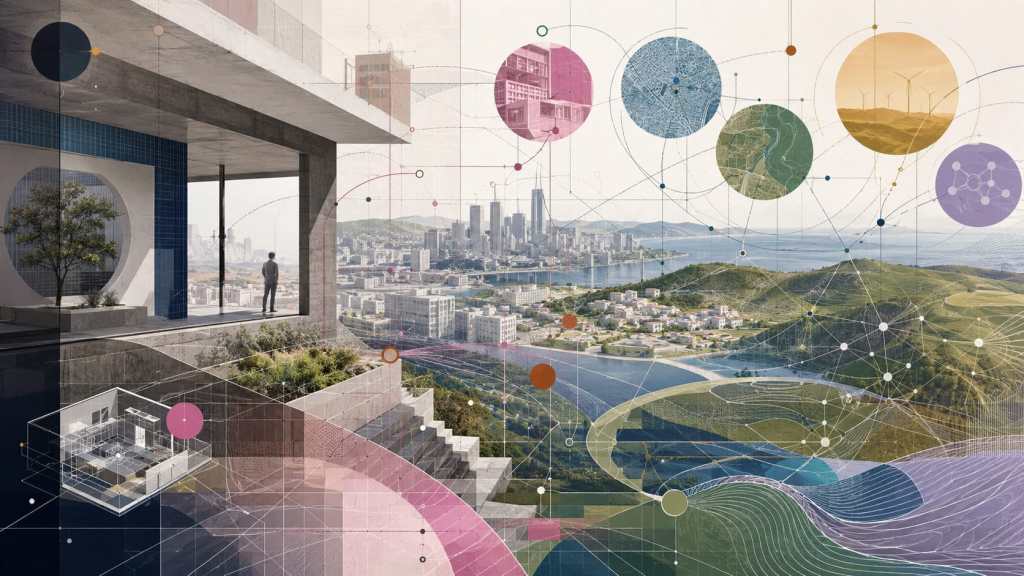
La complessità viene spesso trattata come un fastidio. Entra nei progetti quando una scelta tecnica produce effetti imprevisti, una trasformazione locale apre domande più ampie o quando una soluzione apparentemente corretta diventa fragile appena incontra l’uso reale. A quel punto la complessità viene percepita come un difetto: troppe variabili, troppe competenze, troppe conseguenze da tenere insieme. Eppure, molte situazioni sembrano confuse perché vengono osservate dalla distanza sbagliata. Guardate troppo da vicino, si frammentano in dettagli. Guardate troppo da lontano, diventano astrazioni. La chiarezza nasce dal movimento tra queste distanze: avvicinarsi per capire l’esperienza concreta, allontanarsi per riconoscere il sistema, tornare vicino per verificare se una strategia regge nella realtà quotidiana. È qui che la complessità smette di essere un ostacolo e diventa una forma di conoscenza.
Un progetto appare semplice quando viene isolato dal sistema in cui dovrà coesistere. Si può disegnare un edificio come se il suo perimetro coincidesse con il suo problema. Si può progettare un impianto come se la prestazione esaurisse la sua efficacia. Si può costruire un intervento culturale come se il rapporto con il pubblico iniziasse nel momento dell’apertura. Si può immaginare una trasformazione urbana come se l’immagine finale bastasse a descriverne gli effetti. Queste letture producono oggetti più gestibili, ma spesso meno efficaci. La realtà torna sempre a chiedere ciò che il progetto aveva lasciato fuori. Torna nella manutenzione, nell’uso, nella gestione, nei costi, nella fiducia necessaria a far durare un sistema. Torna nelle persone che adottano una trasformazione o la rifiutano, nei territori che assorbono un intervento o lo respingono, nelle istituzioni che dichiarano apertura e continuano comunque a produrre distanza. La confusione nasce spesso lì: nel ritorno di ciò che era stato escluso troppo presto.
Per questo la pianificazione multiscalare è molto più di uno strumento urbanistico. È una postura progettuale. Abitua a non fidarsi della prima scala di progetto. Insegna che un problema locale può avere radici territoriali, che una decisione tecnica può modificare comportamenti, che una trasformazione visibile può generare effetti meno visibili e più duraturi. Questa capacità dovrebbe entrare molto di più nei progetti contemporanei. Riguarda l’architettura quando lavora su un edificio destinato a vivere dentro una rete di usi e manutenzioni, l’ingegneria quando una soluzione performante dovrà essere compresa, gestita e adottata; la curatela quando una mostra vuole costruire una relazione reale con i suoi pubblici e la ricerca quando un fenomeno perde senso se viene separato dalle condizioni che lo producono.
Ogni progetto guadagna precisione quando viene letto nella sua scala immediata e poi ricollocato nel sistema che lo rende possibile. La scala non coincide sempre con la dimensione fisica. Un intervento piccolo può avere effetti profondi. Può cambiare il modo in cui una risorsa viene percepita, un servizio viene usato, un’istituzione viene riconosciuta. Al contrario, un intervento ampio può restare debole se non incide sulle pratiche concrete. La scala reale di un progetto si misura negli effetti che produce, non soltanto nello spazio che occupa. Questa è una delle questioni più sottovalutate nel progetto contemporaneo. Siamo abituati a pensare che la complessità aumenti con la dimensione. Un grande piano sembra complesso, un piccolo intervento sembra più semplice. Ma spesso una modifica minima attraversa molti sistemi. Ciò che è piccolo nella forma può essere grande nelle conseguenze. La pianificazione territoriale possiede da tempo questa consapevolezza. Quando è praticata nel suo senso più alto, lavora sulle interdipendenze. Riconosce che ogni trasformazione appartiene a una rete di condizioni. Tiene insieme ciò che accade nel punto preciso dell’intervento e ciò che dipende da sistemi più ampi.
Questo approccio dovrebbe contaminare molto di più le altre pratiche progettuali, in quanto non mette in discussione il valore del focus specialistico. Ogni progetto ha bisogno di competenze profonde, di saperi tecnici, di precisione disciplinare. Il problema nasce quando il lavoro specialistico viene attivato prima di aver compreso il sistema di dinamiche in cui dovrà operare. In quel caso l’iperspecializzazione rischia di rendere invisibile ciò che è già presente, ma non ancora palese: dipendenze, effetti indiretti, fragilità gestionali, distanze culturali, ricadute territoriali, condizioni d’uso che non emergono se il problema viene osservato da una sola prospettiva. Per questo sarebbe auspicabile usare con maggiore continuità un approccio multiscalare, tipico dell’urbanistica e della pianificazione territoriale, insieme a una lettura multidisciplinare costruita fin dall’inizio. Prima si riconoscono le dinamiche coinvolte, le scale rilevanti e le relazioni che incidono davvero sulla riuscita del progetto. Poi si può stabilire dove serve l’approfondimento specialistico, con quali confini e con quale consapevolezza.
Il focus specialistico diventa più forte quando sa dentro quale sistema sta intervenendo. La complessità chiede di capire quale scala rende visibile il problema. Un progetto maturo non accumula informazioni per mostrarsi completo. Costruisce una lettura capace di distinguere ciò che è decisivo da ciò che è solo rumore. Sa che ogni intervento richiede una selezione, e che selezionare significa assumersi la responsabilità di ciò che viene messo a fuoco. La chiarezza progettuale nasce da questa responsabilità. Una chiarezza troppo rapida cancella ciò che disturba. Produce immagini ordinate, diagrammi puliti, narrazioni efficaci. Può essere convincente in una presentazione e fragile nella realtà. Una chiarezza più acuta conserva traccia delle tensioni che contano.
Una comunità energetica può essere progettata attraverso dati corretti e tecnologie adeguate. Se viene letta soltanto come sistema di produzione e consumo, una parte del problema resta invisibile. La sua efficacia dipenderà anche dalla fiducia tra i soggetti coinvolti, dalla chiarezza della gestione, dalla distribuzione dei benefici e dalla capacità di diventare pratica quotidiana. La confusione, in questi casi, nasce dal modo in cui le informazioni vengono lette. Per questo la multidisciplinarità diventa davvero utile solo quando interviene nella costruzione della domanda.
La multidisciplinarità dovrebbe contribuire alla costruzione della domanda, non limitarsi alla somma delle risposte. La pianificazione multiscalare dovrebbe diventare una pratica ordinaria di ogni progetto che voglia avere effetti reali, anche quando il progetto non assume la forma di un piano. Quando non vi è una lettura globale delle scale di progetto, questo può sembrare più chiaro. In realtà diventa più fragile.
La complessità va resa attraversabile, comprensibile. La chiarezza migliore non cancella la complessità. Permette di muoversi dentro di essa. Un progetto chiaro costruisce orientamento. Mostra dove agire, quali relazioni considerare, quali effetti monitorare, quali scale tenere aperte. La chiarezza progettuale è una forma di navigazione. Richiede uno sguardo mobile. Troppo vicino, il progetto rischia di perdersi nei dettagli. Troppo lontano, rischia di produrre visioni generiche. La qualità sta nel movimento tra le distanze. Questo movimento è una competenza. Non appartiene solo all’urbanistica, dovrebbe diventare parte del modo in cui pensano architetti, ingegneri, curatori, ricercatori e progettisti culturali. Chi lavora oggi sulle trasformazioni dello spazio, dell’energia, della cultura e dei territori non può permettersi di escludere a priori scale di lettura importanti per le dinamiche coinvolte.
Molti problemi contemporanei sembrano confusi perché sono stati divisi troppo presto. La transizione energetica viene separata dalla fiducia, la rigenerazione dagli effetti sociali, l’accessibilità dalla percezione di legittimità, la cultura dalle condizioni materiali che permettono alle persone di partecipare. Ogni separazione produce un problema più ordinato, ma spesso meno reale. Non basta dire che tutto è collegato. Il punto è capire quali connessioni hanno conseguenze, quali scale spiegano davvero il problema, quale disciplina vede ciò che un’altra lascia fuori. Qui il progetto diventa più rigoroso, non più vago. Diventa capace di scegliere meglio perché vede di più.
La complessità non è confusione, ha bisogno di rigore metodologico. La pianificazione multiscalare e multidisciplinare può offrire al progetto contemporaneo una forma più avanzata di chiarezza. Una chiarezza capace di attraversare le scale e di riconoscere i sistemi in cui ogni trasformazione dovrà vivere. Forse è questa una delle responsabilità più urgenti del progetto oggi: smettere di trattare la complessità come un problema da ridurre e iniziare a considerarla come il luogo in cui nascono le vere trasformazioni.
ENG
Complexity is frequently treated as a nuisance. It enters projects when a technical choice produces unforeseen effects, a local transformation opens up broader questions, or when an apparently correct solution becomes fragile the moment it encounters real-world use. At that point, complexity is perceived as a defect: too many variables, too many expertise areas, too many consequences to hold together. Yet, many situations appear confused simply because they are observed from the wrong distance. Looked at too closely, they fragment into details. Looked at from too far away, they become abstractions. Clarity arises from the movement between these distances: moving closer to understand the concrete experience, stepping back to recognize the system, and returning close to verify whether a strategy holds up in daily reality. It is here that complexity ceases to be an obstacle and becomes a form of knowledge.
A project appears simple when it is isolated from the system in which it must co-exist. A building can be drawn as if its perimeter coincided with its problem. A system can be designed as if performance exhausted its efficacy. A cultural intervention can be constructed as if the relationship with the public began at the moment of opening. An urban transformation can be imagined as if the final rendering were enough to describe its effects. Such readings produce objects that are more manageable, but often less effective. Reality always returns to demand what the project left out. It returns in maintenance, in use, in management, in costs, and in the trust required to make a system last. It returns in the people who adopt a transformation or reject it, in the territories that absorb an intervention or repel it, and in the institutions that declare openness yet continue to produce distance. Confusion is often born right there: in the return of what was excluded too soon.
For this reason, multiscalar planning is far more than an urban planning tool. It is a design posture. It trains one not to trust the first available project scale. It teaches that a local problem can have territorial roots, that a technical decision can alter behaviors, and that a visible transformation can generate less visible, more lasting effects. This capacity should find its way far more into contemporary projects. It concerns architecture when working on a building destined to live within a network of uses and maintenance; engineering when a high-performance solution must be understood, managed, and adopted; curating when an exhibition seeks to build a real relationship with its audiences; and research when a phenomenon loses meaning if separated from the conditions that produce it.
Every project gains precision when read at its immediate scale and then repositioned within the system that makes it possible. Scale does not always coincide with physical dimension. A small intervention can have profound effects. It can change how a resource is perceived, how a service is used, or how an institution is recognized. Conversely, a large-scale intervention can remain weak if it fails to impact concrete practices. The true scale of a project is measured by the effects it produces, not just the space it occupies. This is one of the most underestimated issues in contemporary design. There is a habit of thinking that complexity increases with size. A large-scale plan seems complex; a small intervention seems simpler. Yet, often, a minimal modification ripples through multiple systems. What is small in form can be large in consequences. Territorial planning has long possessed this awareness. When practiced in its highest sense, it works on interdependencies. It recognizes that every transformation belongs to a network of conditions. It holds together what happens at the precise point of intervention and what depends on broader systems.
This approach should contaminate other design practices far more, as it does not challenge the value of specialized focus. Every project requires deep expertise, technical knowledge, and disciplinary precision. The problem arises when specialized work is activated before understanding the system of dynamics within which it must operate. In that case, hyperspecialization risks rendering invisible what is already present but not yet obvious: dependencies, indirect effects, managerial fragilities, cultural distances, territorial repercussions, and conditions of use that do not emerge if the problem is observed from a single perspective. For this reason, it would be desirable to use a multiscalar approach—typical of urban and territorial planning—with greater continuity, alongside a multidisciplinary reading constructed from the very beginning. First, the dynamics involved, the relevant scales, and the relationships that truly impact the success of the project are recognized. Then, it can be established where specialized depth is required, within which boundaries, and with what level of awareness.
The specialized focus becomes stronger when it knows within which system it is intervening. Complexity demands an understanding of which scale makes the problem visible. A mature project does not accumulate information merely to appear complete. It constructs a reading capable of distinguishing what is decisive from what is merely noise. It knows that every intervention requires a selection, and that to select means to assume responsibility for what is brought into focus. Design clarity is born from this responsibility. A clarity achieved too quickly erases what disturbs it. It produces orderly images, clean diagrams, and effective narratives. It can be convincing in a presentation and fragile in reality. A more acute clarity retains traces of the tensions that matter.
A renewable energy community can be designed using correct data and appropriate technologies. If it is read solely as a system of production and consumption, a part of the problem remains invisible. Its efficacy will also depend on the trust between the subjects involved, the clarity of management, the distribution of benefits, and the ability to become a daily practice. Confusion, in these cases, arises from the way information is read. This is why multidisciplinarity becomes truly useful only when it intervenes in the construction of the question.
Multidisciplinarity should contribute to the construction of the question, not limit itself to the sum of the answers. Multiscalar planning should become an ordinary practice for every project that aims to have real effects, even when the project does not take the form of a physical plan. When there is no global reading of the project scales, the intervention may seem clearer; in reality, it becomes more fragile.
Complexity must be made traversable, comprehensible. The best clarity does not erase complexity; it allows one to move within it. A clear project builds orientation. It shows where to act, which relationships to consider, which effects to monitor, and which scales to keep open. Design clarity is a form of navigation. It requires a mobile gaze. Too close, the project risks getting lost in the details. Too far away, it risks producing generic visions. Quality lies in the movement between distances. This movement is a competence. It does not belong solely to urban planning; it should become part of how architects, engineers, curators, researchers, and cultural designers think. Those working today on the transformations of space, energy, culture, and territories cannot afford to exclude a priori scales of reading that are important for the dynamics involved.
Many contemporary problems appear confused because they were divided too soon. The energy transition is separated from trust, regeneration from social effects, accessibility from the perception of legitimacy, and culture from the material conditions that allow people to participate. Every separation produces a more orderly problem, but often a less real one. It is not enough to say that everything is connected. The point is to understand which connections carry consequences, which scales truly explain the problem, and which discipline sees what another leaves out. Here, the project becomes more rigorous, not vaster. It becomes capable of making better choices because it sees more.
Complexity is not confusion, it requires methodological rigor. Multiscalar and multidisciplinary planning can offer contemporary design a more advanced form of clarity. A clarity capable of traversing scales and recognizing the systems in which every transformation must live. Perhaps this is one of the most urgent responsibilities of design today: to stop treating complexity as a problem to be reduced, and to begin considering it as the place where true transformations are born.


Rispondi