
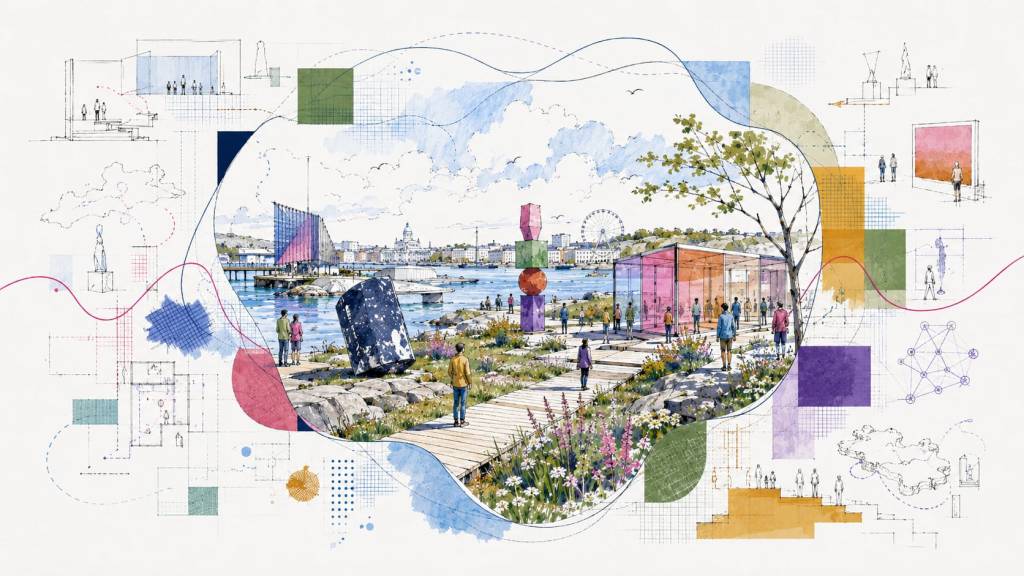
La Biennale di Helsinki: quando l’isola diventa mostra
A Vallisaari, natura protetta, infrastrutture militari e accesso marittimo entrano nel dispositivo curatoriale. Il caso mostra come un territorio possa amplificare una mostra proprio perché conserva la capacità di modificarne scelte, percorsi e condizioni di visita.
Helsinki Biennial: When the Island Turns into Art
At Vallisaari, protected nature, military infrastructure, and maritime access enter into the curatorial device. The case demonstrates how a territory can amplify an exhibition precisely because it retains the capacity to modify its choices, routes, and visiting conditions.
Caso/Case: Helsinki Biennial, Vallisaari
Scala/Scale: isola e rete urbana / Island and urban network
Orizzonte progettuale/Strategic Vision: costruire una biennale attraverso la relazione tra arte, natura e città marittima / Building a Biennial Through the Relationship Between Art, Nature, and the Maritime City
Domanda/The Issue: che cosa cambia quando il luogo espositivo possiede condizioni ecologiche, storiche e logistiche che la curatela non può neutralizzare? / What shifts when an exhibition space carries ecological, historical, and logistical conditions that curatorial practice cannot neutralize?
Questo articolo sviluppa la cornice teorica delineata in “La curatela artistico – territoriale: un manifesto per il museo come infrastruttura”. Leggi l’analisi completa qui.
This article expands on the theoretical framework outlined in “Artistic-Territorial Curating: A Manifesto for the Museum as Infrastructure“. Read the full analysis here.
English version below
ITA
La visita a Helsinki Biennial comincia prima dell’incontro con la prima opera. Occorre raggiungere il porto, attendere il traghetto e attraversare il tratto di mare che separa Helsinki da Vallisaari. Una volta sbarcati, il percorso si sviluppa tra sentieri, fortificazioni, edifici militari dismessi e aree naturali protette. Il viaggio, le condizioni atmosferiche e la conformazione dell’isola modificano il tempo della visita. Si entra in uno spazio espositivo ancora connesso alla città e al clima, nel quale distanze, orientamento, pause e imprevisti appartengono all’esperienza quanto le opere.
La prima edizione, The Same Sea, si è svolta nel 2021 con più di quaranta artisti e gruppi. Una parte consistente dei lavori era costituita da nuove commissioni o opere site-specific, distribuite lungo i percorsi all’aperto e all’interno di polveriere ed edifici storici. La conformazione di Vallisaari entrava così nella costruzione del progetto curatoriale, intervenendo sulla successione delle opere e sul modo in cui potevano essere raggiunte. Questa relazione dipende dalla particolare condizione ambientale e storica dell’isola. Vallisaari è un’area sottoposta a tutela, caratterizzata da ecosistemi sensibili e da un patrimonio militare stratificato. Le proposte artistiche e le possibili collocazioni devono confrontarsi con gli enti responsabili della gestione naturalistica e della conservazione. Sistemi di fissaggio, scavi, uso della roccia, accesso agli edifici e prossimità alle aree più fragili non possono essere decisi esclusivamente sulla base dell’efficacia espositiva. Alcune installazioni richiedono strutture autoportanti o interventi minimi; altre devono essere riposizionate o adattate alle condizioni del sito.
La natura, in una manifestazione ambientata in un contesto così riconoscibile, potrebbe facilmente diventare una cornice simbolica del discorso curatoriale. A Vallisaari, invece, la tutela produce conseguenze operative: limita ciò che può essere costruito, modifica tecniche e materiali e costringe le opere a negoziare con un territorio che l’istituzione non controlla interamente. È questa capacità di porre condizioni a rendere l’isola parte attiva della mostra.
La terza edizione, Shelter, ha reso ancora più esplicita l’attenzione verso le forme di vita e gli habitat di Vallisaari. Artisti e collettivi sono stati distribuiti tra l’isola, HAM Helsinki Art Museum e l’Esplanade Park, costruendo una biennale articolata attraverso ambienti urbani differenti. Le tre sedi producono modalità diverse di incontro. Vallisaari richiede una visita intenzionale, un viaggio e una permanenza prolungata. HAM offre le condizioni più stabili dello spazio museale. L’Esplanade Park permette un contatto meno programmato, inserito nei percorsi quotidiani della città. Questa estensione amplia la geografia pubblica della Biennale. All’intensità dell’esperienza insulare affianca modalità di partecipazione più immediate e accessibili, senza ridurre le sedi sulla terraferma a semplici sostituti dell’isola. Nel 2025 la maggior parte degli incontri con la manifestazione è avvenuta attraverso le installazioni collocate nel parco urbano, mentre Vallisaari ha conservato il carattere di esperienza più deliberata e territorialmente immersiva. La distribuzione delle sedi rende visibile una caratteristica delle esposizioni territoriali: la forza specifica di un luogo e la sua accessibilità non coincidono automaticamente.
L’ingresso alla Biennale è gratuito, ma raggiungere Vallisaari richiede un traghetto, un biglietto e una disponibilità di tempo compatibile con gli orari del collegamento. Il terreno presenta tratti irregolari, salite e spazi interni che non possono essere attraversati nello stesso modo da ogni visitatore. Le condizioni meteorologiche incidono inoltre sull’esperienza più di quanto accadrebbe in una sede museale convenzionale. Si tratta soprattutto di caratteristiche proprie dell’isola, non di barriere deliberate dall’istituzione. Entrano, però, necessariamente nella progettazione della visita. Se il territorio contribuisce al significato delle opere, anche le differenti possibilità di attraversarlo diventano una questione curatoriale.
La Biennale ha risposto progressivamente attraverso informazioni sull’accessibilità, riduzione dei costi di trasporto, giornate con traghetto gratuito e ampliamento delle sedi sulla terraferma. Queste misure non rendono Vallisaari equivalente a uno spazio urbano pianeggiante, ma costruiscono più soglie di accesso e riconoscono che l’esperienza insulare non può rappresentare l’unica forma di partecipazione.
Anche la fragilità ambientale del sito richiede una gestione continua. Nel 2021 alcune aree erbose hanno mostrato segni di erosione legati all’afflusso dei visitatori. Trasporti, produzione e funzionamento delle installazioni concorrono inoltre all’impronta climatica della manifestazione. È una tensione strutturale per ogni evento capace di attrarre un pubblico numeroso in un ambiente delicato. La visibilità culturale può aumentare la pressione sullo stesso ecosistema che rende l’esperienza possibile.
Il caso di Helsinki è rilevante anche perché questa tensione viene osservata e tradotta in scelte operative. Il monitoraggio può orientare percorsi, trasporti, distribuzione delle presenze, materiali e decisioni curatoriali successive. Il territorio fornisce così i parametri attraverso cui l’evento calibra la propria presenza. Helsinki Biennial mostra che una sede territoriale può generare relazioni tra opere difficilmente ricostruibili all’interno di un edificio. Il mare separa e prepara la visita; la vegetazione interrompe la continuità visiva; le fortificazioni inseriscono i lavori in una storia materiale precedente all’esposizione; la distanza tra le installazioni impedisce una fruizione rapida e uniforme. Questa intensità richiede un’infrastruttura complessa. Trasporti, tutela, sicurezza, manutenzione, accessibilità e capacità di carico del sito entrano nel progetto insieme alla selezione delle opere e all’allestimento. La curatela si estende alle condizioni attraverso cui il pubblico può raggiungere la mostra e il territorio può sostenerne la presenza.
L’aspetto trasferibile della Biennale non consiste nell’impiego spettacolare di un’isola, ma nel metodo attraverso cui le caratteristiche del luogo intervengono sul progetto. Competenze artistiche, ambientali e conservative vengono integrate; gli effetti prodotti dalla visita sono osservati; l’evento si distribuisce tra modalità di accesso differenti. Vallisaari partecipa alla curatela perché conserva la capacità di modificare collocazioni, tecniche, percorsi e organizzazione della manifestazione. Helsinki Biennial rende così visibile una condizione essenziale delle mostre territoriali: quando il luogo entra realmente nel progetto, la curatela non lo utilizza soltanto per intensificare l’esperienza. Deve imparare a lavorare con ciò che il territorio permette, richiede e rende impossibile.
ENG
The visit to the Helsinki Biennial begins before encountering the first artwork. One must reach the harbor, await the ferry, and cross the stretch of sea separating Helsinki from Vallisaari. Upon disembarking, the route unfolds along footpaths, fortifications, decommissioned military structures, and protected natural areas. The journey, the weather conditions, and the topography of the island alter the temporal rhythm of the visit. Visitors enter an exhibition space still connected to the city and the climate, where distances, orientation, pauses, and unforeseen variables belong to the experience as much as the artworks themselves.
The first edition, The Same Sea, took place in 2021 featuring more than forty artists and collectives. A significant portion of the work consisted of new commissions or site-specific pieces distributed along outdoor paths and inside gunpowder magazines and historical buildings. The physical layout of Vallisaari thus entered directly into the construction of the curatorial project, intervening in the sequence of the works and the ways in which they could be reached. This relationship depends on the island’s distinct environmental and historical condition. Vallisaari is a protected area, characterized by sensitive ecosystems and a layered military heritage. Artistic proposals and potential placements must be negotiated with the authorities responsible for nature management and historical conservation. Mounting systems, excavations, the use of rock surfaces, access to buildings, and proximity to fragile areas cannot be decided solely on the basis of display efficacy. Certain installations require self-supporting structures or minimal interventions; others must be repositioned or adapted to the site’s constraints.
In an event set within such a distinct context, nature could easily become a mere symbolic backdrop for the curatorial narrative. At Vallisaari, however, conservation produces operational consequences: it limits what can be built, alters techniques and materials, and forces artworks to negotiate with a territory that the institution does not entirely control. It is precisely this capacity to impose conditions that renders the island an active participant in the exhibition.
The third edition, Shelter, made the focus on Vallisaari’s life forms and habitats even more explicit. Artists and collectives were distributed across the island, the HAM Helsinki Art Museum, and Esplanade Park, building a biennial articulated through different urban environments. The three venues generate distinct modes of encounter. Vallisaari demands an intentional visit, a journey, and an extended stay. HAM offers the more stable conditions of the conventional museum space. Esplanade Park allows for less programmed engagement, woven into the daily routines of the city. This expansion broadens the Biennial’s public geography. To the intensity of the insular experience, it joins more immediate and accessible modes of participation, without reducing the mainland venues to mere substitutes for the island. In 2025, the majority of encounters with the event occurred through the installations situated in the urban park, while Vallisaari retained its character as a more deliberate and territorially immersive experience. The distribution of sites makes visible a key feature of territorial exhibitions: the specific power of a place and its accessibility do not automatically coincide.
Admission to the Biennial is free, yet reaching Vallisaari requires a ferry trip, a ticket, and a availability of time compatible with the transit schedule. The terrain features uneven paths, inclines, and interior spaces that cannot be traversed in the same manner by every visitor. Furthermore, weather conditions impact the experience far more than would occur in a conventional museum venue. These are primarily intrinsic characteristics of the island, rather than deliberate barriers erected by the institution. They must, however, enter into the design of the visit. If the territory contributes to the meaning of the works, then the varying possibilities of traversing it likewise become a curatorial concern.
The Biennial has progressively responded through accessibility information, reduced transit costs, free ferry days, and the expansion of mainland locations. These measures do not render Vallisaari equivalent to a flat urban space, but they construct multiple entry thresholds and recognize that the insular experience cannot constitute the sole form of participation.
The environmental fragility of the site also demands ongoing management. In 2021, certain grassy areas showed signs of erosion linked to visitor flow. Transportation, production, and the operation of installations further contribute to the carbon footprint of the event. This represents a structural tension for any event capable of attracting large audiences to a delicate environment. Cultural visibility can increase pressure on the very ecosystem that makes the experience possible.
The case of Helsinki is notable precisely because this tension is observed and translated into operational choices. Monitoring can inform routes, transit logistics, crowd distribution, materials, and subsequent curatorial decisions. The territory thus supplies the parameters through which the event calibrates its presence. The Helsinki Biennial demonstrates that a territorial venue can generate relationships between artworks that would be difficult to construct within a building. The sea separates and prepares the visit; the vegetation interrupts visual continuity; the fortifications embed the works within a material history preceding the exhibition; the distance between installations prevents rapid and uniform consumption. This intensity requires a complex infrastructure. Transportation, conservation, safety, maintenance, accessibility, and the site’s carrying capacity enter into the project alongside artwork selection and display design. Curating extends to the conditions through which the public can reach the exhibition and the territory can sustain its presence.
The transferable aspect of the Biennial lies not in the spectacular use of an island, but in the methodology through which the characteristics of the site intervene in the project. Artistic, environmental, and conservation expertise are integrated; the effects generated by the visit are observed; the event is distributed across different modes of access. Vallisaari participates in the curating because it retains the capacity to modify placements, techniques, routes, and the organizational framework of the event. The Helsinki Biennial thus reveals an essential condition of territorial exhibitions: when a place truly enters into the project, curating does not merely use it to intensify the experience. It must learn to work with what the territory permits, demands, and renders impossible.


Rispondi